
I wasn’t at the US Open this year.
I was in Melbourne, watching from the other side of the world. The matches, obviously, but increasingly everything happening around them.
My feed began filling with tennis. Not just the tournament itself, or the campaigns that inevitably arrive with a Grand Slam, but everything gathering around it across New York. Racquets were being wrapped. T-shirts printed. Newspapers passed around. Public courts turned into meeting places. Coffee came with something to read.
I started saving things.
At first I thought I was collecting interesting activations.
By the end of the fortnight, I realised I was watching something else.
The US Open created the gravity, but much of the interesting cultural activity around it came from people bringing their own worlds to tennis rather than trying to look like the US Open.
Racquet Club at the Seaport
Racquet probably made the biggest physical statement.
For 21 days, Racquet Club at the Seaport turned part of Lower Manhattan into something between a tennis club, magazine, shop and social space. There was a full-size court, clubhouse, retail, screenings, conversations, clinics, parties and somewhere to have a drink afterwards.
But it was the programming that made it interesting.
One day might bring a podcast recording, another a film screening, a Babolat playtest or an Overset grip station. There was a one-point tournament with Bageled NYC. People could play, watch, listen, browse or simply spend time there.
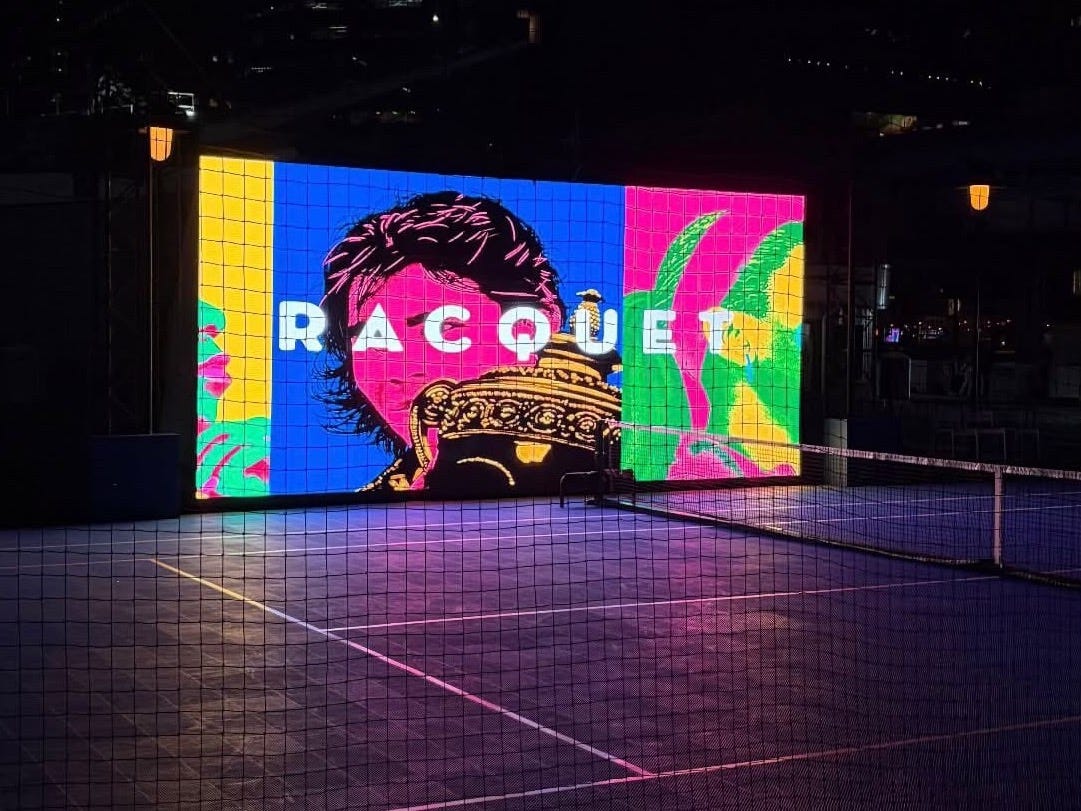
From Melbourne, it looked less like a conventional activation and more like Racquet had made its editorial world physical.
The most convincing things I saw weren’t borrowing tennis for a fortnight. They felt like extensions of something that already existed.
Hard Court, in the room
Jessica Schiffer’s Hard Court brings a fashion and business journalist’s eye to tennis, reporting on the people, deals and cultural shifts shaping the game beyond the baseline.
During the Open, the community forming around it became physical too.
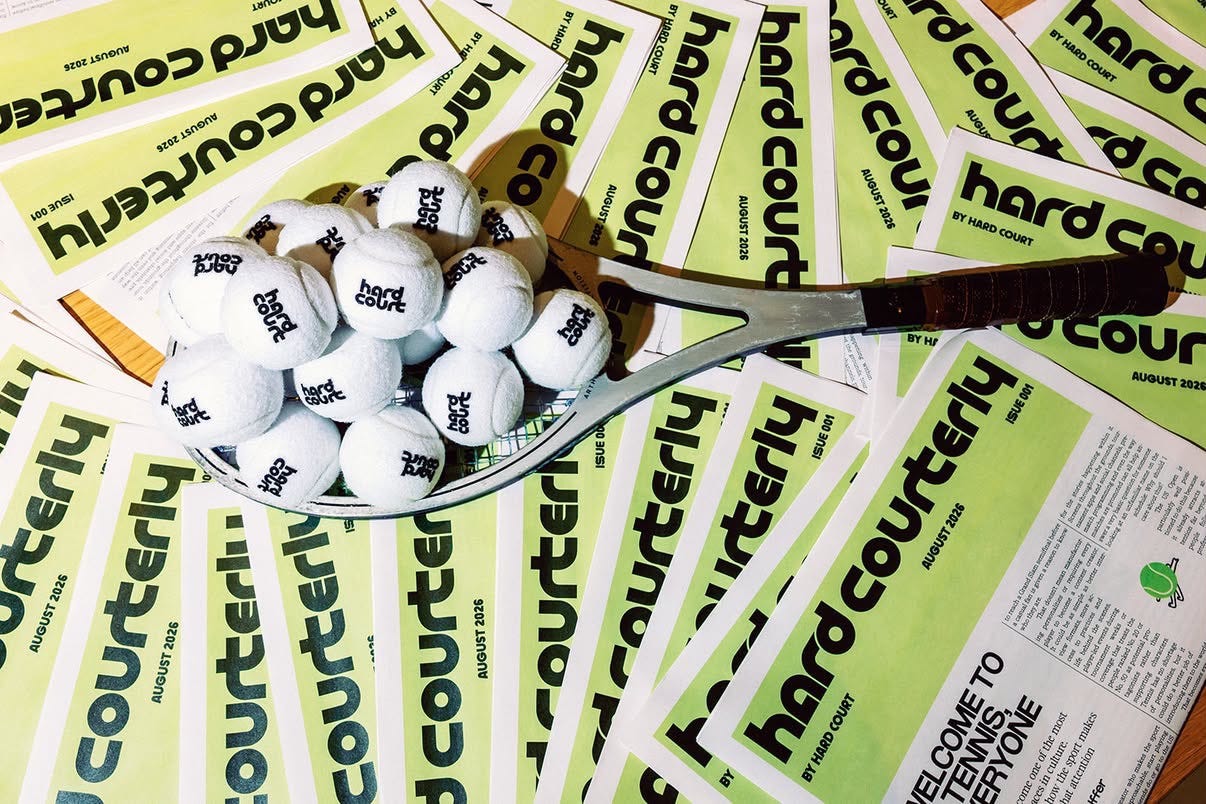
For Hard Court’s inaugural cocktail party, Schiffer brought together writers and creators, agents, brand executives and others shaping the culture around the game. She has written that she wanted to create the kind of room she wished existed more often in tennis, one where people from different corners of the game felt equally welcome and might actually meet one another.
Hard Court had spent the year reporting on the people, ideas and changes happening around tennis. For one night, some of that world was simply in the same room.
The publication wasn’t only documenting a culture. It was beginning to help bring one together.
A court was remembered before it was renewed
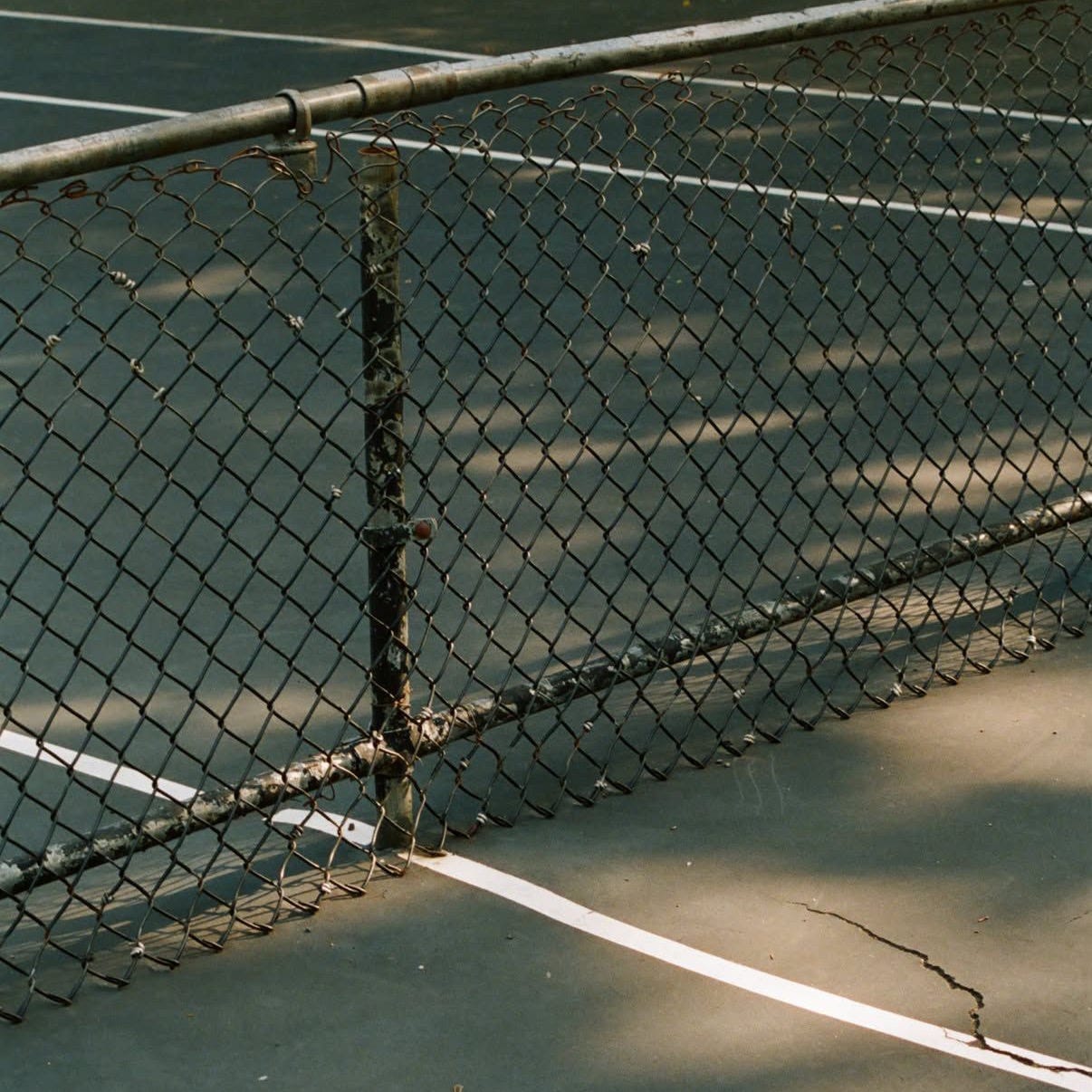
At Marcy Playground in Brooklyn, photographer Vicente Muñoz documented the public courts in their final days before they were refurbished.
During the Open, those photographs became Marcy, an exhibition at Nike NYC’s 47 Chrystie space, accompanied by a free zine collecting and archiving memories of the park.
The worn surface. The faded markings. The court before the improvement.
What stayed with me was the decision to photograph it at all.
Tennis has a fascination with immaculate surfaces: fresh lines, perfect grass, untouched clay. But most of us experience the game somewhere else entirely. Courts with cracks, fading paint, old nets and years of other people’s matches embedded in them.
Here, the worn court wasn’t simply something to fix. Someone thought it was worth recording first.
And perhaps that’s the more familiar version of a tennis court anyway. Not centre court before the first ball is struck, but the places most of us actually play. Used, weathered and imperfect.
Sometimes all that use is exactly what gives a court its story.
The ordinary rituals
Some of the ideas I kept returning to were much smaller.
Overset makes patterned overgrips. At Racquet’s Seaport club, its Wrap & Rally put the product into use. Racquets were regripped on site, with players choosing an Overset grip around the on-court activity.
Elsewhere, reString and Valldoreix built a pop-up around restringing. Players could bring in their own racquets and have them restrung with reString strings while learning more about the product.
Different brands, different scales, but the same thing interested me.
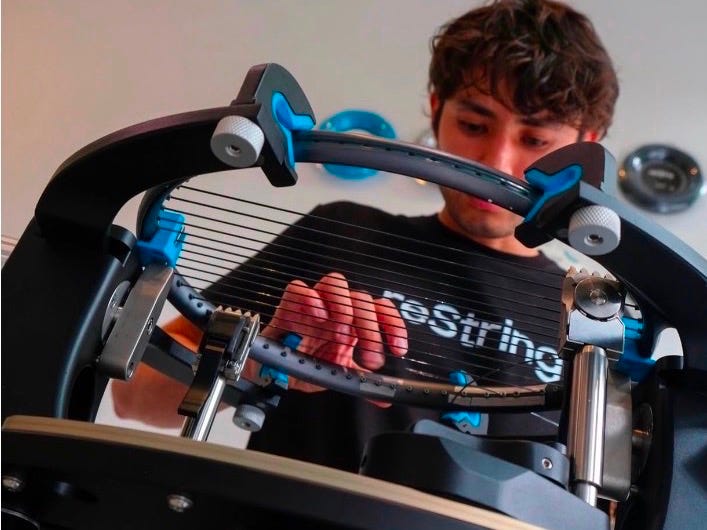
They didn’t need to invent much entertainment around the product. The doing was the interesting part.
Choose something. Hand over something you already own. Watch someone work on it. Leave with it slightly changed.
Those ordinary rituals around tennis have an intimacy that perhaps gets overlooked when the focus is always on the match itself.
Wrapping a grip. Choosing a string. Packing a bag. Tying your shoes.
They’re small acts, but they are part of how people live the game.
Something worth keeping
Yonex opened a Coffee House on Mott Street.
There were racquets and product, coffee and Yonex Edition No. 1, a zine made with The Second Serve. Inside were player interviews, photography and stories about equipment and the people behind it.
It was something to take away and read.
Come in for coffee. Find a racquet. Pick up something to read. Leave carrying a little more than you expected.
Temporary spaces disappear quickly. A physical object extends the encounter.
A publication ends up on a coffee table. A photograph gets pinned to a wall. A T-shirt gets worn again six months later.
Perhaps that’s why some of the smallest objects from the fortnight felt more memorable than the largest installations.
The Unofficial Shop
One idea I kept coming back to was The Unofficial Shop, created by Tennis T-Shirts with Complex.
For five days on Broadway, it brought together 32 collaborators from across tennis, fashion, art and culture to create more than 50 T-shirt designs.
What interested me was who got to be in the room.
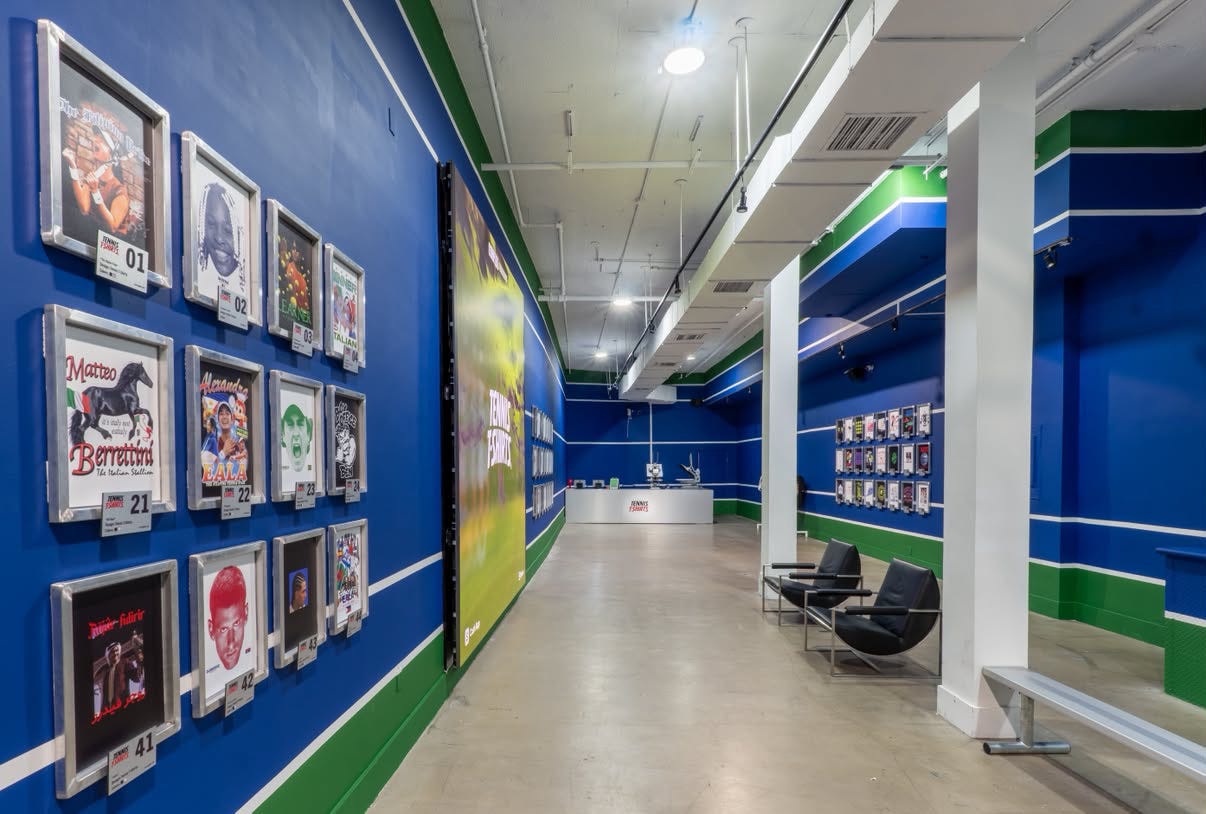
Alongside more recognisable names were smaller independent tennis brands and creative projects. Some I knew. Some I didn’t. That was part of the appeal.
Rather than one big brand interpreting tennis for everyone, the shop gave a collection of smaller voices space to show what tennis looked like through their eyes.
Visitors chose a graphic and a shirt and had it printed on demand. So the souvenir wasn’t really the US Open T-shirt. It was whichever version of tennis you happened to connect with.
There’s something interesting about that at a moment when so many small tennis brands, publications and creative projects seem to be appearing.
And maybe that is partly what “unofficial” allows.
Not anti-tournament. Not trying to compete with the US Open. Just enough space around something enormous for smaller voices to make things in response to it.
The Open, outside the Open
By the end of the fortnight, I had saved far more than I could ever fit here.
There were independent brands sharing spaces, products being personalised, books and magazines appearing around the game, postcards, disposable cameras, match-used balls, trading cards, coffee and objects made from old tennis nets.
Some were polished. Some were tiny. Some probably reached only a roomful of people.
Together, though, they made New York feel as though the Open had escaped the grounds.
That might be the thing I found most interesting from the other side of the world.
A Grand Slam is enormous enough to create its own cultural orbit. For a few weeks, tennis becomes a language lots of different people are suddenly speaking. The interesting part is what happens when they speak it in their own accent.
What connected the things I kept saving wasn’t really scale or budget. Each came from somewhere that already had its own point of view.
A publication remained a publication. A photographer photographed. A grip company wrapped racquets. Independent designers made their own souvenirs.
The Open simply gave them a moment in which tennis mattered a little more than usual.
From Melbourne, I found myself wondering less about how any of these ideas could be replicated here and more about what might emerge around our own tennis summer in our own way.
Melbourne’s own publications, designers, players, clubs, cafés, photographers, makers and communities finding their way into the game.
Because perhaps the most interesting thing happening around the US Open wasn’t any single activation I saved.
It was seeing how much room there still is around tennis for people to make something of their own.
New York’s fortnight is almost over.
The season turns south.
And January suddenly doesn’t feel very far away.