
The Pull Towards Play is a series of short portraits of real tennis players from around the world. Not professionals. Just people who keep showing up, for reasons that are hard to name and impossible to ignore.
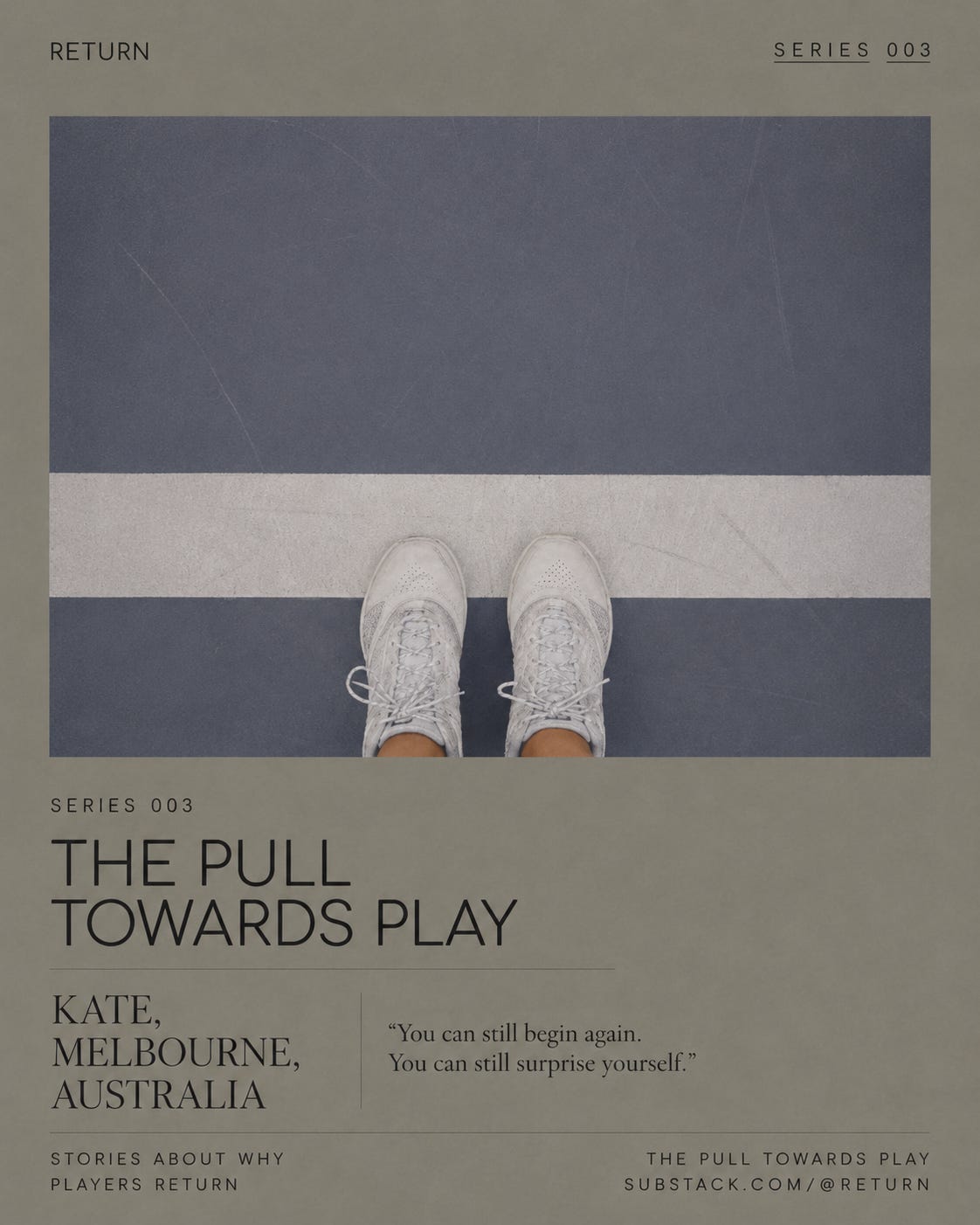
KATE: MELBOURNE, AUSTRALIA
There was a backhand she couldn’t fix.
She had tried everything. The grip. The stance. The point of contact. She would isolate one thing, work on it, decide that wasn’t it, and move to the next. Kate had spent thirty years as an aircraft design engineer, a career built entirely on precision and problem solving, and she brought that same methodical intelligence to the court. If something wasn’t working there was a reason. Find the reason. Fix it. Move on.
The backhand kept breaking down. The frustration built. The harder she thought about it the worse it got.
Then one day she stopped trying. She let the shot happen. And it did, clean and natural, as if her body had been waiting patiently for her mind to get out of the way.
Kate grew up in China, where she became a semiprofessional volleyball player before injury took it from her. She was young when it happened, young enough that the sport was not just something she did but something she was. Losing it meant losing a version of herself she had not finished becoming yet.
She built another life. Thirty years of engineering, countries moved through. London. America. Children raised and grown. And then Covid, and a decision that still sounds a little crazy when she says it out loud. She moved to Australia. Alone. In her fifties.
Tennis was not the plan. It rarely is for the people it takes hold of most completely. It started simply, a way to stay active, a way to meet people in a city that did not know her yet.
Tennis suited her in the same way engineering had. Precision. Repetition. Adjustment. Small variables with large consequences. She studied the game, felt her way into it, and kept showing up. Most people who play against her have no idea who they are facing. They just see a woman who plays powerfully. They don’t see everything that built her.
“There is something about tennis that feels very honest,” she says. “You are alone with yourself out there. Your emotions, your thoughts, your confidence, your fears. Everything shows up.”
She knows what it means to have a body that can do extraordinary things. She also knows what it means to lose that. So when tennis began giving something back, in early mornings on court with the sound of the ball and the laughter of people who had become friends, she recognised what she was feeling. Not exercise. Not competition. Belonging.
She plays every day. Still improving, still discovering, still arriving at moments on court where her body knows before her mind does. “You can still begin again,” she says. “You can still surprise yourself.” The game just asks her to show up, stop thinking, and let something else take over.
She does. Every morning.
Enough to be there again tomorrow.