
The Pull Towards Play is a series of short portraits of real tennis players from around the world. Not professionals. Just people who keep showing up, for reasons that are hard to name and impossible to ignore.
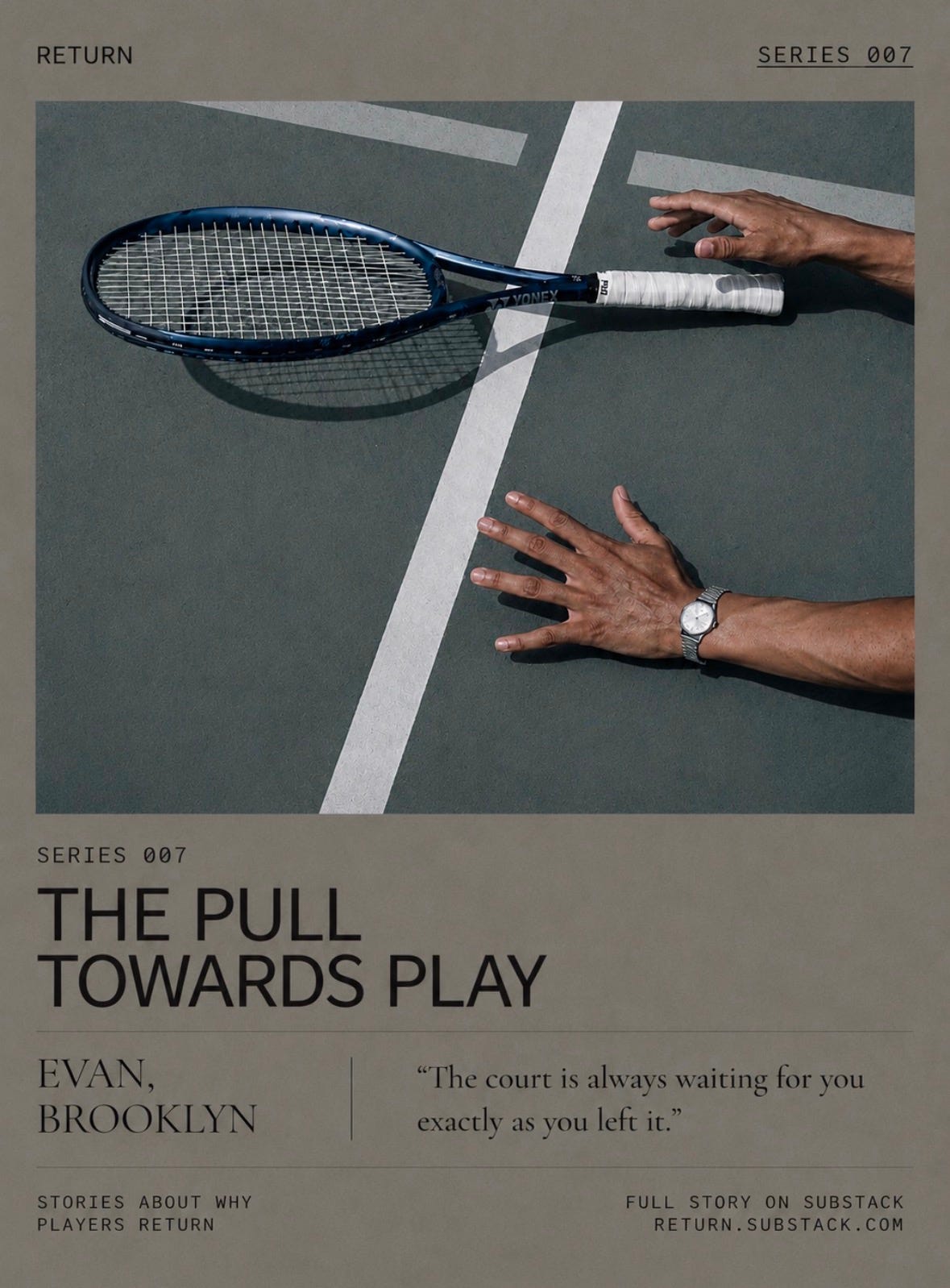
EVAN COLE, BROOKLYN
In 2015, Dustin Brown beat Rafa Nadal at Wimbledon.
It was a second round match that had no right to be what it became. Brown, dreadlocked and unpredictable, playing the kind of tennis that looked like it was being invented in real time. Evan watched it and kept wanting more.
He found Serena next. Watched everything. Went down rabbit holes. Found the YouTube channels with five minutes of C’mons and studied them the way other people study film. What drew him wasn’t just the tennis. It was watching someone succeed in a space that was designed without them in mind. He has never had a lesson. When he first started playing he simply emulated what he had watched for years. Serena’s mechanics. Her mannerisms. The way she moves through a point. It is, he admits, a little strange.
By then tennis had become the constant in his life. Georgetown came and went. Brooklyn became home. Somewhere in the middle of that he started making the kind of tennis stories he couldn’t find anywhere else.
“For a long time I waited for someone else to make the kind of work I wanted to see. Eventually I realised that maybe I was the person who was supposed to make it.”
Racquet Theory exists because Evan sees tennis everywhere. In fashion, architecture, design, music, photography, health, luxury, status, identity and relationships. Once he started paying attention he realised the game wasn’t confined to the court. It was embedded in culture. He wanted to document all the places where those worlds overlap. In nine months, he built sixty stories and a readership of more than 5,000 people.
He couldn’t find a place for people who thought about tennis the way he did, so he built one.
He doesn’t think tennis has a reach problem. He thinks it has a relevance problem.
He sat in a meeting with the head of one of the Grand Slams and was told they only speak to platforms with a minimum of 100,000 followers. It confirmed something he’d been thinking for a while: too much of tennis was trying to manufacture culture instead of documenting the culture that already existed.
“Relevance is greater than reach.”
That way of seeing doesn’t switch off when he leaves the court. At least once a week he finds himself thinking about the Naomi Osaka and Jen Brady 2020 US Open semifinal. Six years later, he still thinks that match doesn’t get talked about enough.
This is how his mind works. He’s interested in what sits beneath the surface of the game. The stories people overlook. The moments that linger long after everyone else has moved on.
The court itself is something else entirely. The most constant thing in a decade of change. No matter where he is in the world, those lines, those dimensions, and that feeling never change.
Every meaningful decision he has made over the last year has led him back to tennis. He has stopped trying to explain why.
Instead, he talks about the court.
“There’s something comforting about knowing that while everything else evolves, the court is always waiting for you exactly as you left it.”