
The Pull Towards Play is a series of short portraits of real tennis players from around the world. Not professionals. Just people who keep showing up, for reasons that are hard to name and impossible to ignore.
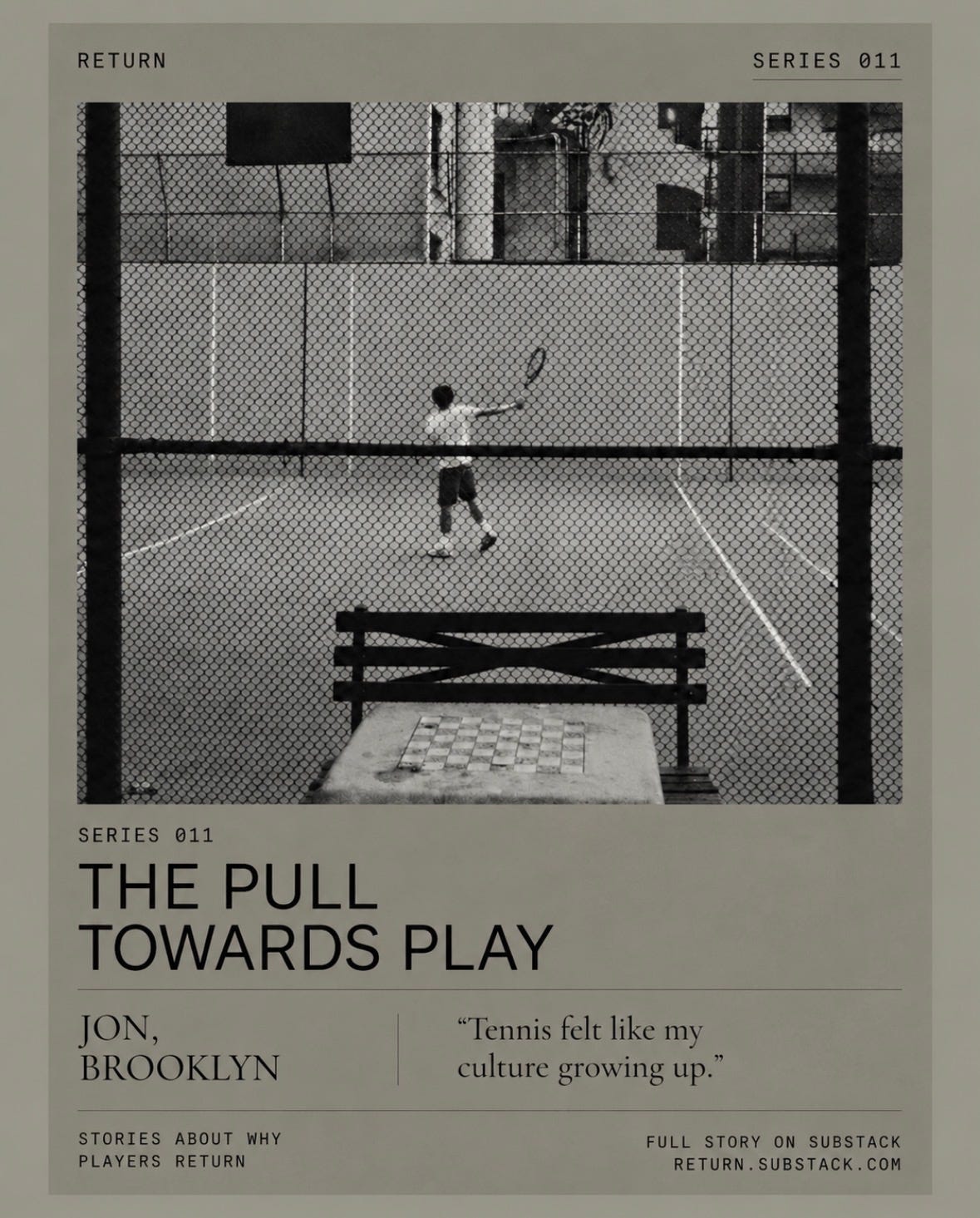
JON, BROOKLYN
Jon was three years old when a racquet was put in his hand. He never gave it back.
He grew up in a multiracial household, moving between worlds that didn’t always have a name for what he was. He was looking, the way everyone looks at that age, for something that felt like his. Something with a code, a set of rules, an unspoken understanding between the people who belonged to it.
Tennis gave him that.
Not the trophies. Not the rankings. The way you carry yourself on court. The way you treat your opponent. The language players speak to each other without speaking. The thing that happens in the first few minutes of hitting with someone new, when you both understand, without saying anything, exactly who you are dealing with. He had found his culture. He just hadn’t expected it to come with a racquet.
He played competitively for years, then spent a decade teaching the game. Became a hitting partner for a pro. Moved through the tennis world the way someone moves through a place they love, slowly, paying attention, not in a hurry to leave.
It was in those years on court with ordinary people that he found the moments he still carries.
There was a father going through a divorce who wanted to learn tennis. Not for fitness. Not for competition. To have something to share with his kids again. Jon taught him. Watched him find his footing on court the same way he was trying to find his footing everywhere else. Tennis became the bridge between a man and his children at the moment they needed one most.
There was a junior player preparing to apply for college. Talented but uncertain. He needed more than coaching. He needed someone who believed in what he could become off the court as well as on it. Jon wrote his admission recommendation letter.
There was a kid going through something she couldn’t name out loud. Something difficult and private and heavy. She came to the court anyway. Jon let the court be what it needed to be for her. A place where none of it had to be spoken. Where the ball going back and forth was enough.
He thinks about all three of them still.
Tennis gave each of them something different. What it gave Jon was the understanding that the game was never really about the game. It was about what happened between people because of it. The unspoken language. The safe space.
He still plays. When he strips everything away, no camera, nothing to prove, nothing to build, he says a kid shows up. Present, curious, emotionally raw. Beneath that kid, though, is still a serious competitor. The desire to win never fully goes quiet. He is still learning to let the kid stay.
On the days when he manages it, when the kid and the competitor find a way to coexist, he describes the feeling as an unlikely combination. A kill switch that fires, deep and instinctive. And underneath it, stillness. Inner peace. Tennis as spiritual experience. He means that literally. The game showed him how he operated. How he processed emotion, handled pressure, moved through difficulty.
He is building something now. Something for players in New York, built not around skill level but around common ground. The idea underneath it is the same one the game taught him years ago on court with a divorced father, a nervous junior, a kid who needed somewhere safe. The right match is rarely just about tennis. It is about who you end up talking to afterwards. Where the conversation goes. What stays.
The court is where relationships start. Not where they end.
Enough to be on court again tomorrow.