
The Pull Towards Play is a series of short portraits of real tennis players from around the world. Not professionals. Just people who keep showing up, for reasons that are hard to name and impossible to ignore.
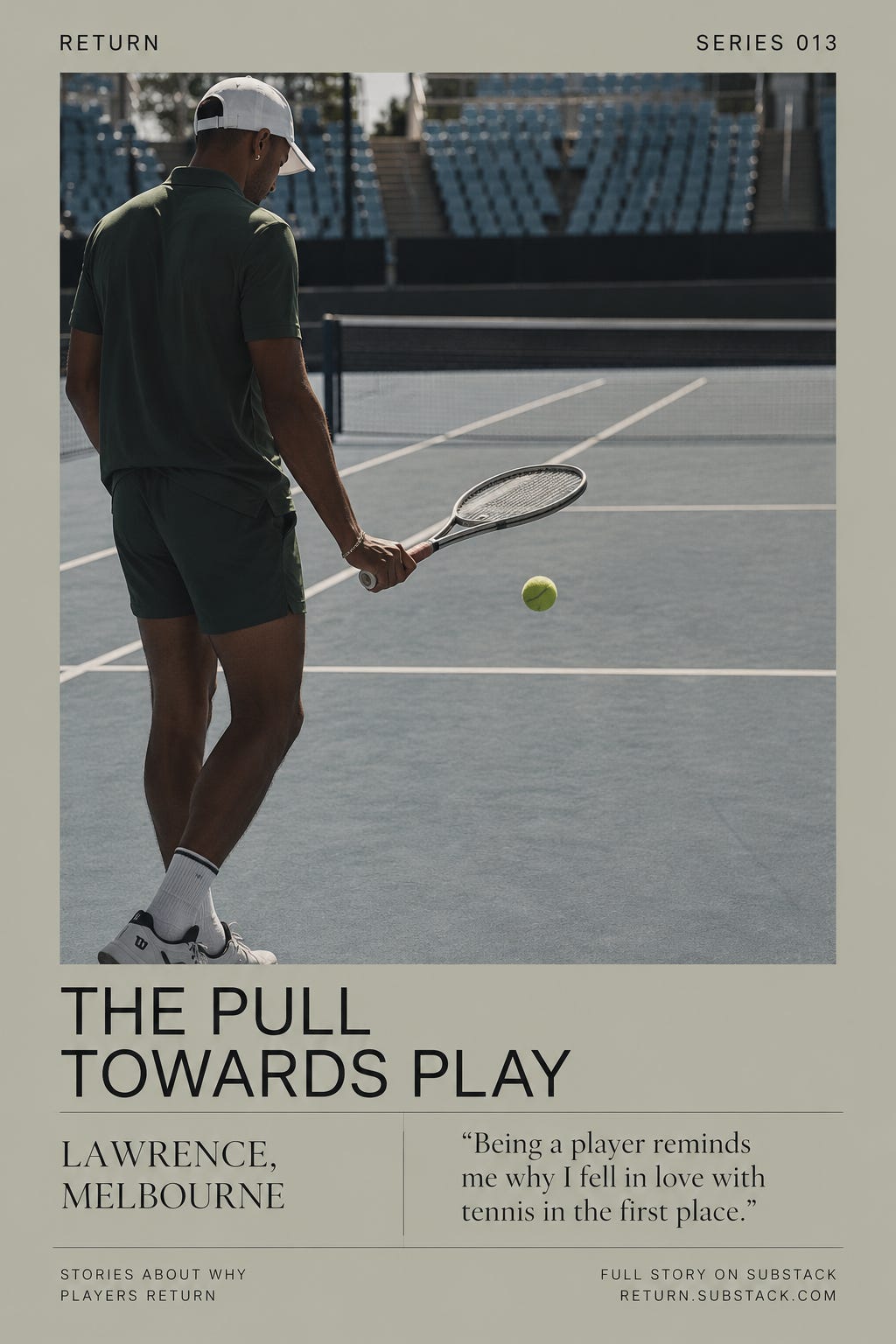
LAWRENCE, MELBOURNE
South Auckland, 2005. A television, and on it, Roger Federer.
It was the Australian Open semifinal, Federer against Marat Safin. Lawrence had never had a lesson. There wasn’t much tennis where he grew up, and no obvious way into it. What he had was the screen, and the way Federer moved across it. Nothing looked forced. The ball seemed to go wherever it was asked.
Federer lost that match. It didn’t matter. Lawrence was already gone.
He wanted to find out what it felt like from the inside. And early on, the game gave him something he needed more than technique. When things around him were hard, tennis was somewhere to put his attention. For as long as he was watching the ball, everything else could wait.
“It gave me something to look forward to, something to work towards,” he says, “and eventually something that became a huge part of my identity.”
He ended up in Melbourne. Played for his university, singles and doubles. Became a coach.
Then came an injury, surgery, and a stretch with the use of only one arm. Ordinary things he had never thought about became problems to solve. And he couldn’t play.
He realised how much he missed it. Not the exercise. The feeling of being on court. His clients. Watching his players improve. Being connected to the game at all.
He came back. He coaches full time now, at Melbourne Park.
His days start with coffee. Always coffee. Then they are spent reading the game for other people. Every shot, every decision, someone else getting better. He loves it. The people. The laugh in the middle of a session. The moment someone finally gets the thing they have been chasing.
He cares how he looks out there. Classic warm-up jackets, traditional court shorts, his own personality layered over the top. Tennis has a long history of style, and he wants to respect it while making it his own.
Playing is different again. He doesn’t get to do it much anymore. Weekends, when he can, a hit with his mates. Then the nerves come back. The excitement. The frustration. Everything he reads in other people’s games, felt in his own.
And sometimes, the other thing. Moving well, striking clean, completely present. For a few points, nothing looks forced.
“Being a coach has taught me to understand the game,” he says. “Being a player reminds me why I fell in love with tennis in the first place.”
More than twenty years ago, a boy in South Auckland watched Melbourne Park on television, with no obvious way in.
Now he works there.
Every day, he helps someone else find theirs.