
The Pull Towards Play is a series of short portraits of real tennis players from around the world. Not professionals. Just people who keep showing up, for reasons that are hard to name and impossible to ignore.
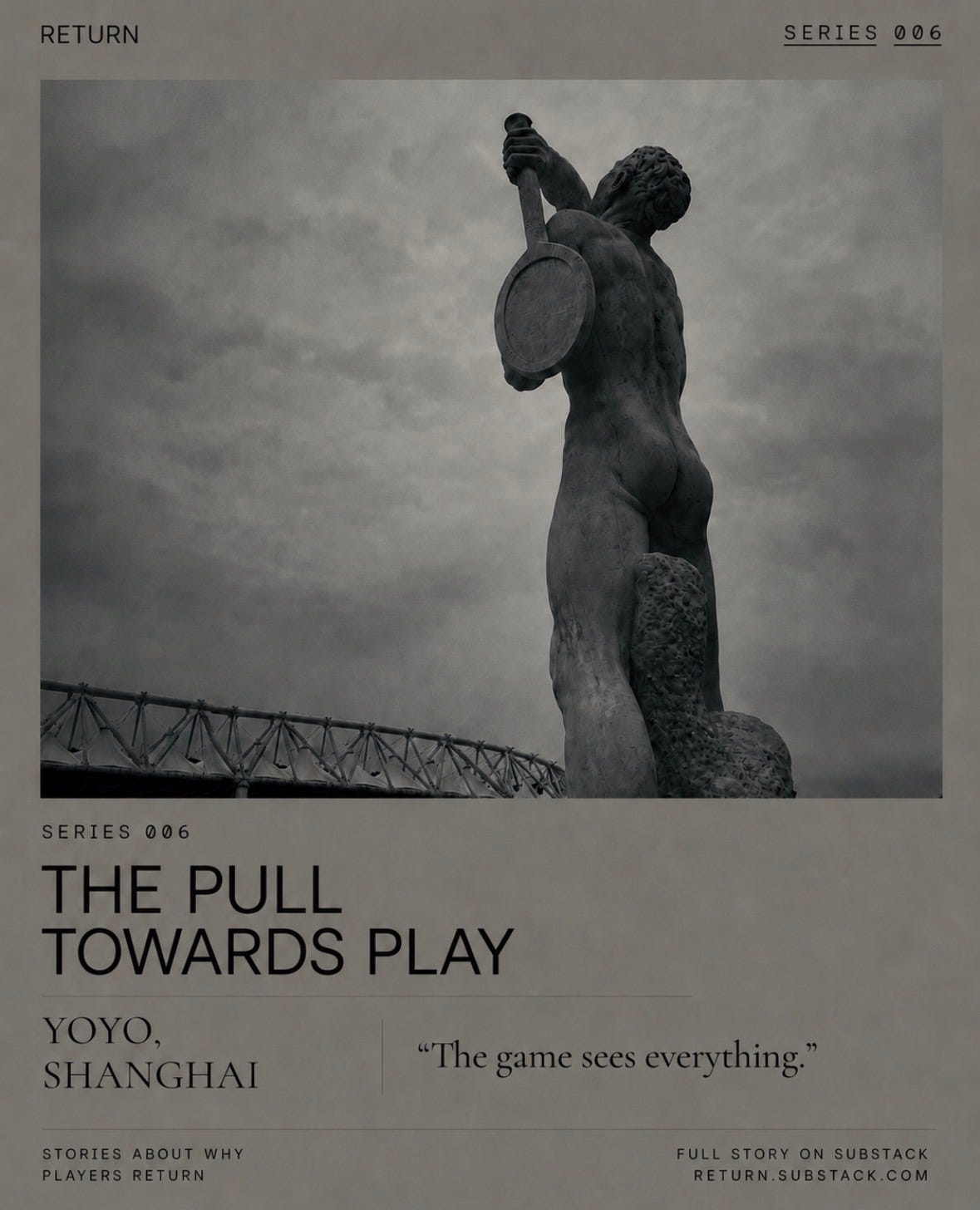
YOYO: SHANGHAI
In Rome, she looked up.
Above the clay courts of the Foro Italico, marble figures stand at their highest points, racquets raised, bodies frozen mid-swing. They have been there since the 1930s. They do not move. They do not tire. They do not double fault.
She had her camera. She pressed the shutter.
Yoyo is based in Shanghai, where she co-founded CEMENT, a creative agency working at the intersection of art, culture and contemporary life. In her spare time she is a multimedia artist. She has been doing it long enough to know what she is looking for before she arrives somewhere, and to recognise it when it appears.
Tennis found her early. Her parents introduced her to the game in 2002, watching the Shanghai Masters Cup together. Something stayed. The two worlds, art and tennis, have never been separate for her. In both she finds the same things. Creativity. The need to adapt. The moment when preparation runs out and you simply have to respond.
When she picks up a camera at a match she sets a theme first. In Rome it was the sculptures, the juxtaposition of the still and the moving, the perfect marble body and the imperfect human one below it, trying to become something close. In Shanghai it was the fans, the young kids, the energy in the stands. Her next theme will be emotions. She is still waiting for the right moment to reveal itself.
This is how she moves through the world. With a frame in mind. With a sense of what belongs inside the picture and what stays out.
In 2019 she was at Wimbledon as a reporter. Credentialled, seated at a desk, there to write about what happened.
What happened was Djokovic beat Federer in five sets. For a Federer fan, it was a particular kind of loss.
During the trophy ceremony, the sadness took over.
Then she sat back down at her desk.
“I had to put those personal emotions aside to properly write about Novak Djokovic. I felt like I had a bigger responsibility to convey the story and the overall atmosphere. While personal touches are necessary to make the writing engaging, there is absolutely no room for bias.”
She wrote the piece. She did her job. The feelings went somewhere else.
Behind a lens she can only focus closely on a single subject. Everything else falls away. She decides what enters the frame. She decides what stays outside it. This is the work. This is also, in some way, the protection.
On court as a player, none of that is available to her.
She is hyper-aware of her own actions, her partner’s movements, her opponent’s intentions. She can feel her own nerves. There is no viewfinder to look through. No choice about what to include and what to leave out.
The game sees everything.
Behind the camera, she chooses what enters the picture. On court, she doesn’t get that choice. The nerves enter. The doubt enters. The missed shot enters. Everything enters.
Because for someone who spends her life observing the world, tennis is one of the few places where she has no option but to be inside it.
The frame disappears.